
Why measurement comes first
In sport science, the gap between what we think is happening and what is actually happening is where most poor decisions are made. A runner feels slow, so they add volume. A lifter feels strong, so they load the bar. Without data, both are guesses — and guesses are why progress stalls and injuries recur.
At The MET Hub, we begin every relationship with measurement. Before we prescribe a single exercise, we want to know how you produce force, how you use oxygen, and where your real limits sit. That is the FLUXLab approach: profile first, programme second.
What we actually measure
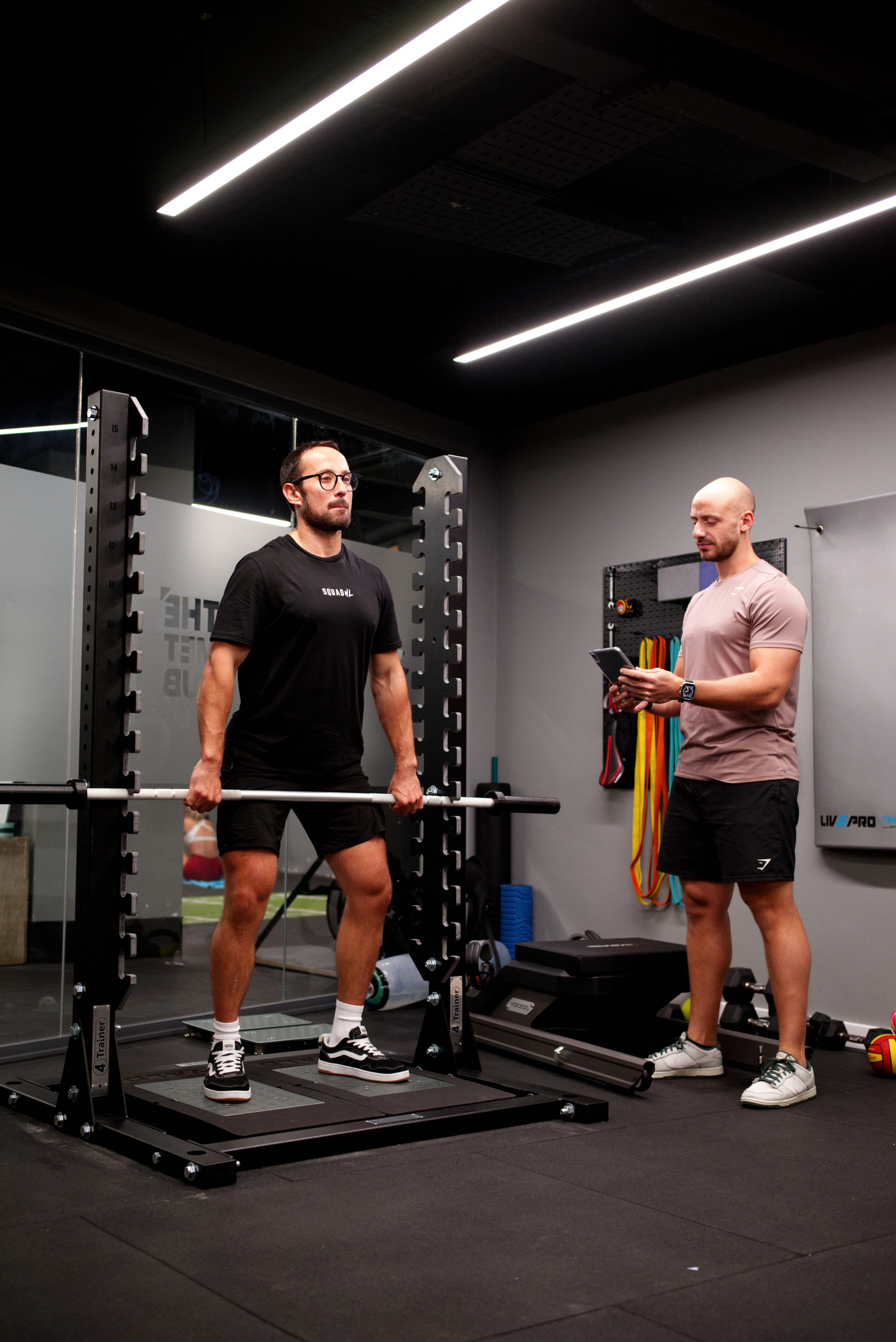
FLUXLab brings metabolic and mechanical testing under one roof. On the metabolic side, VO2 max and lactate profiling map the engine — how your body consumes oxygen and clears fatigue by-products across intensities. On the mechanical side, force plates and isometric dynamometry map the chassis — how much force you produce, how quickly, and how symmetrically.
Together, these two streams tell us not just how fit you are, but why. A plateau in running performance is rarely a fitness problem alone; it is often a strength or economy limitation that metabolic testing alone would miss. Equally, a strength deficit that looks obvious in the gym can be irrelevant if your sport never demands that pattern at that load.
From numbers to programme
The point of testing is not a report you frame on the wall. It is a programme that adapts. Your zones, your strength targets, your return-to-sport milestones — all of them are set from your own data and re-tested at sensible intervals. When the numbers move, the plan moves with them.
This is what separates a data-driven plan from a templated one. A template assumes you are average. Your data proves you are not.
Honest accountability
Measurement also keeps us honest. When return-to-play is decided by a force-plate asymmetry closing below a threshold, rather than by how the athlete "looks" in training, both sides are protected — the athlete from coming back too soon, and the clinician from a biased eye.
The same applies to performance. If your VO2 max has not moved in eight weeks despite hard training, the training is the problem, not your effort. The numbers remove the argument.
Who this is for
FLUXLab is not reserved for elite athletes. The recreational runner who keeps picking up the same niggle, the masters athlete whose times have plateaued, the post-surgical patient who wants a clear return-to-sport roadmap — all of them benefit from the same standard of measurement. The threshold for "good enough" is not your level of competition; it is whether the plan is built on your data or on someone else's.
If you have never been tested, you are training on assumption. FLUXLab exists to replace that assumption with evidence.
Do more. Right.
Whether you are returning from surgery, chasing a personal best, or simply training for longevity, the principle holds: measure before you treat, and let the data carry the decision. That is the FLUXLab approach, and it is the standard we hold every plan to.